Nine Weeks on the Bark "Erna"

At the docks of Bremerhaven, a port about 30 miles from the town of Bremen by train, on October 25, 1870, the noise was loud and overwhelming. Ships came in and out, and passengers jostled among merchants, dock hands, and ship crews. Many passengers lined up with their few belongings to board ships. One man, his wife, and their children were part of this crowd: Martin Zapalač (42), his wife, Marianna [Mary] (39), and their children, Johann [John] (7), Rosara [Rosalie] (3), and Johann (age not stated). From the small village or hamlet of Neu Hrozenkau [Novy Hrozenkov], then part of the Austro-Hungarian Empire (now part of the Czech Republic), they left behind their family, relatives, friends, and the life they had known. First, they crossed the border into what was becoming the North German Confederation, and then into the free city-state of Bremen. Wealthier emigrants came by train or coach; poorer ones walked. [1]
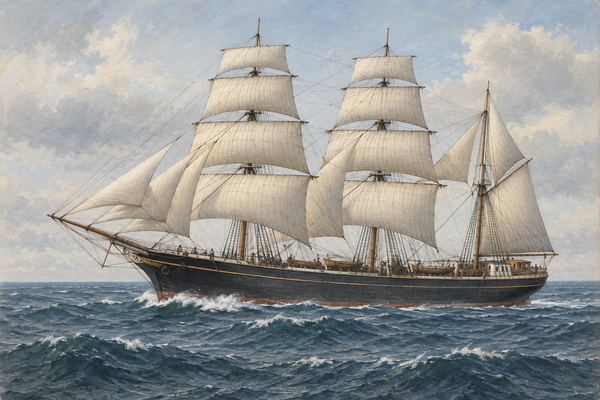
They must have been overwhelmed by the thousands of people milling around. They stood in line to board the ship Bark Erna, a three-masted ship whose tallest mast rose as high as a nine- or ten-storied building. The crossing to Galveston, Texas, would take nine weeks. Within a few years, these ships would be replaced by steamships, and the passage would take only a few days. We can only guess what they went through to reach this boarding line: questions from the brusque emigrant officers, sour looks at the country-style clothing they wore and the bundles they carried.
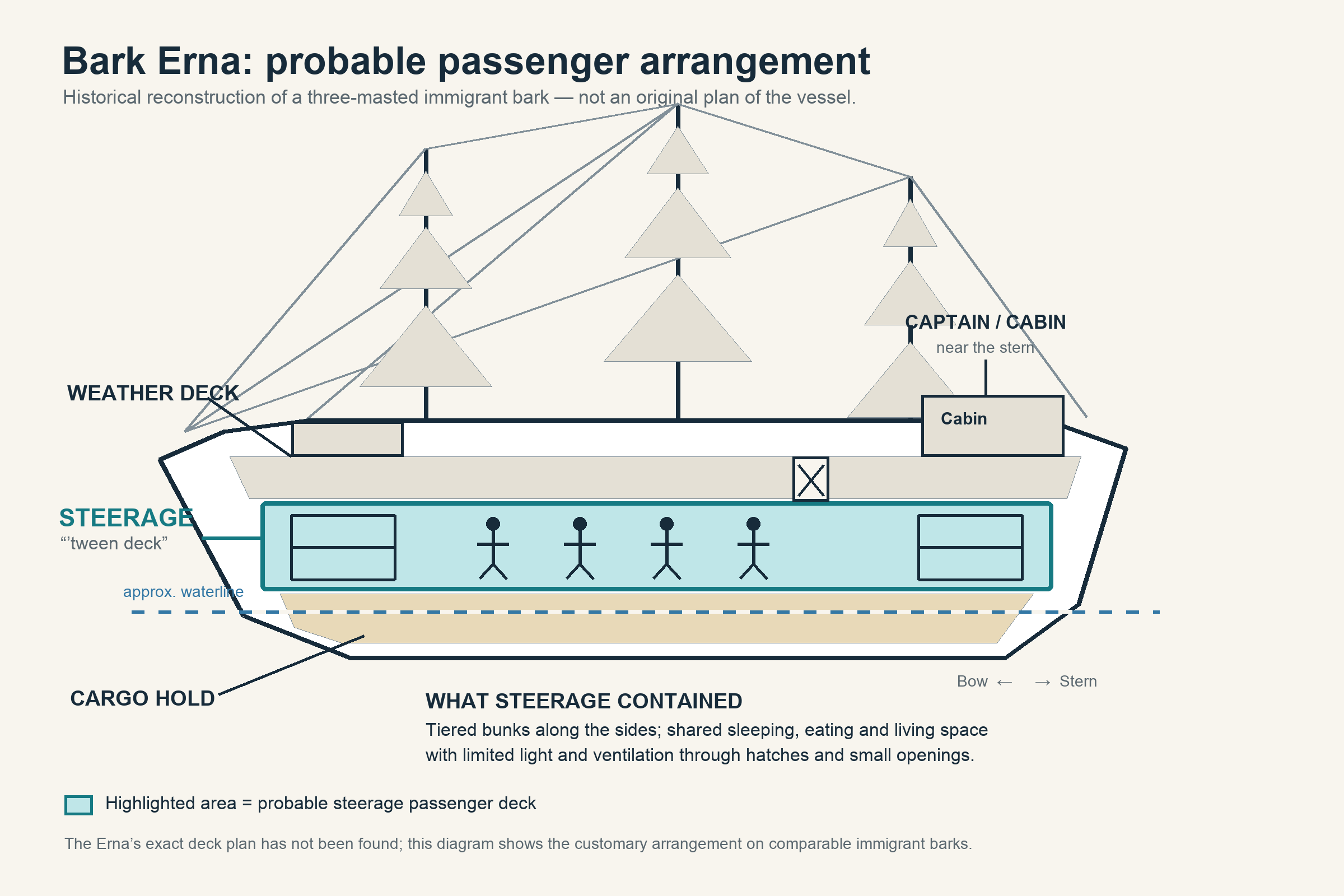
As steerage passengers, they generally occupied a communal “between-deck” below the weather deck. Closely arranged wooden berths, but limited under Bremen regulations to two tiers, accommodated adults and children. The compartment also functioned as their principal living space during the crossing. [2] During this passage, they lost Johann (age not stated), perhaps just an infant, or possibly born during this time. [3] We will never know whether the crowded, unsanitary conditions were to blame. Where there had been hope, there was now despair and further suffering for the parents.
Once they arrived in the port of Galveston, they were herded into immigrant arrival buildings along the wharf, questioned again by stern-faced men who spoke their language and compared the passenger list names to match the names recorded at Bremerhaven. Before they were allowed to leave, they were asked more questions about their health, finances, ability to support themselves, and destination. [4] Outside they would have seen something new to them. Slavery had only ended five years before, and Martin and his family may have been struck by all the African-descended workers at the docks. This new land was a different world from what they had left behind. How the Zapalačs got to the little town of Dubina is unknown. They may have walked or hired a wagon to transport them. But they, like other Czech families, had hopes and dreams for themselves and their children in this new country.
- Linda Schaitberger, Early American History: Rigors of the Journey Made by German Emigrants to the U.S. (https://www.revisionist.net/hysteria/german-exodus.html : accessed 21 September 2026).↩︎
- “Emigration Vessel—Between Decks,” Illustrated London News, May 10, 1851, Library of Congress, Prints and Photographs Division, Library of Congress (https://www.loc.gov/item/2004670977/ : accessed 23 September 2026).↩︎
- Galveston Immigration Foundation, database, Galveston Immigration Database (https://ghf.destinationnext.com/immigration/Search.aspx : accessed 22 September 2026); Family: Zapalac, Arrival Date: December 28, 1870, Vessel: Erna.↩︎
- Ibid.↩︎
Written by
What's Next?

The Railroad Runs in the Family!
On one of our RV trips, we had stopped in the town of Claremore, Oklahoma, in 2024 to visit the Will Rogers Museum. While in the museum, we kept hearing that the "Big Boy" would come through the next day and stop for only 30 minutes before heading to the next stop. Everyone in town seemed excited and planned to attend. We learned that the "Big Boy" was the largest steam-engine freight-hauling locomotive that was ever built and was traveling across the United States. Union Pacific built 25 "Big B
Three Cultures and a Wedding: San Fernando Cathedral
By the time Alejandro and Carmen exchanged vows there, San Fernando Cathedral had already witnessed nearly two centuries of people arriving from elsewhere and calling San Antonio home. Founded by families from the Canary Islands, the small parish church built its first walls in 1731 and was initially called Villa de San Fernando de Béxar. Then Mexican, then American hands rebuilt it after war, fire, and flood, layering a Gothic-revival face over its eighteenth-century Spanish masonry without los
Worm Gruntin' and Family Roots - Searching for Emily in Sopchoppy, Florida
If you know where Sopchoppy, Wakulla County, Florida, is... well, you must either live there or live nearby, since it is not a very big place or known for having many famous people from the area. However, there is one thing that it is famous for, charming worms [Yes, you heard that right!] out of the ground during its annual American Worm Gruntin' Festival. It sounds like fishing must be really popular around there, eh? However, for me, Sopchoppy is famous as the place where my 2nd Great-grandmo
Maryland, Antietam, and a Possible Ancestor's Fate
I've been to Maryland several times — some trips purely for pleasure and sightseeing, others for genealogy research. One of the places we visited that has stayed with me is the site of the Civil War Battle of Antietam, also known as the Battle of Sharpsburg. Many of the young men who woke up that morning were also in Maryland for the first time. But they were not there for pleasure — they were there for war, and for many, for death. At this point, I have not confirmed any ancestors who fought i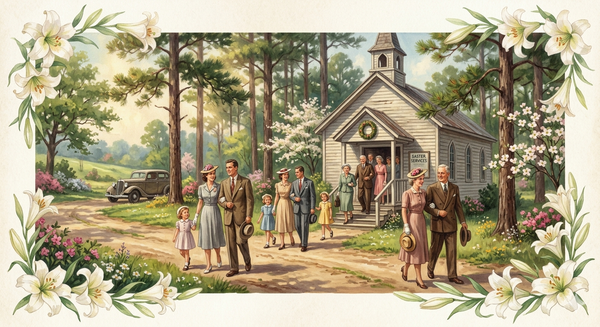
Easter Lilies, April 5, 1942
This Sunday, April 5, 2026, is Easter! In the South, children wake up and see what the Easter Bunny brought them. In their Easter basket, small chocolate eggs or perhaps a large chocolate bunny can be found with other candy such as jelly beans and marshmallow Peeps. It is the time that Christians celebrate the resurrection of their Lord and Savior, Jesus Christ. People come to church dressed in their best clothes to hear the priest or pastor speak about eternal life, forgiveness, and spiritual r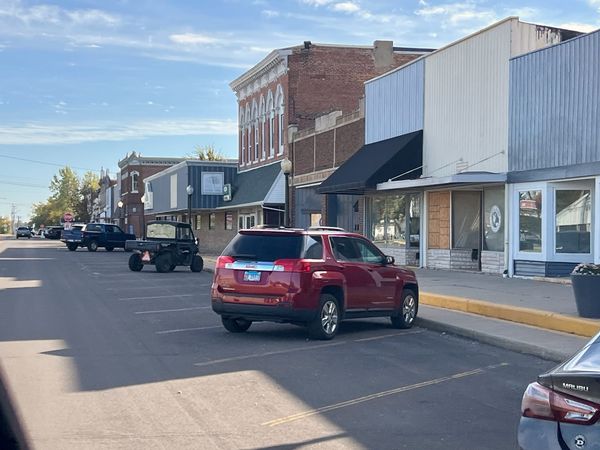
Leaving Minonk
The Eiben Family and the Road to Texas In the 1880s and 1890s, Minonk, Illinois, sat at the junction of multiple major rail lines. The city of Minonk, located in Woodford County, also had numerous new German immigrants who had come to work in the coal mines, supply lumber to the booming city of Chicago, or farm the surrounding area and nearby lands in LaSalle County. We had decided to detour to LaSalle and Woodford Counties to research my mother-in-law's family, the Eibens. Her great-grandfa