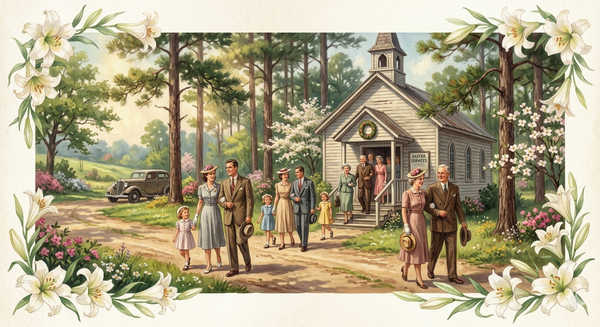
Easter Lilies, April 5, 1942

This Sunday, April 5, 2026, is Easter! In the South, children wake up and see what the Easter Bunny brought them. In their Easter basket, small chocolate eggs or perhaps a large chocolate bunny can be found with other candy such as jelly beans and marshmallow Peeps. It is the time that Christians celebrate the resurrection of their Lord and Savior, Jesus Christ. People come to church dressed in their best clothes to hear the priest or pastor speak about eternal life, forgiveness, and spiritual renewal. They gather for the midday meal — dinner, as folks in the South called it — with ham, sweet potato casserole, or scalloped potatoes. Pound, Syrup, or Angel Food cake were also favorites, along with buttermilk, custard, strawberry, peach, or chocolate pies. Then there was the Easter egg hunt! The day before, children helped dip hard-shell boiled eggs in brilliant shades of purple, blue, red, yellow, and bright green. These, and perhaps plastic eggs (filled with small toys, candy, or change), are hidden by their parents the night before for later discovery.
This yearly scene is a tradition, but I was thinking about another Easter, April 5, 1942, in Beaumont, Texas. This was a different Easter, but perhaps a more meaningful one for the people in the South. On most Sundays, you would see many people attending church, and very few businesses would be open due to the "Blue Laws" in Texas. But it was different this year; the local shipyards, refineries, and other businesses were operating 7 days a week, 24 hours a day, to support the war effort.
I know my mother's family (and my father's family) usually attended services at South Park Baptist Church on Sundays. We also followed that tradition when we visited my grandmother at Easter. But that Sunday, my grandparents and their children might have been attending church at Palestine Baptist Church near my great-grandfather, George Allen Perkins' home in Grant, Louisiana. At our family reunions, my mother and her cousins had always mentioned that my great-grandfather insisted his nine children and their families visit him on the holidays. It was a tradition held as firmly as any church service. This gathering became more important when two of my great-grandfather's four adult sons would soon be called to serve. John Calvin Perkins, 35, was later wounded serving in the Field Artillery in Germany in 1944. George Perkins' youngest son, Barney Allen Perkins, 27, served in General George Patton's Military Police in Germany in 1945. Many of George's grandsons would also serve in both the Atlantic and Pacific theaters.[1] But sitting together in that church on Easter Sunday, 1942, neither brother nor anyone gathered there that morning could have known what lay ahead. Yet not everything was running at full speed. Rationing of rubber tires had begun, and shortages were starting to appear, especially in sugar, meat, gasoline, and leather goods.
But this industrious activity came with sacrifices that sermons could not completely erase, and my grandparents knew better. They had known war before, just like their parents, their grandparents, and great-grandparents! But this Sunday was special and even more fitting for the realities of war! It was Easter and their faith that kept them and their ancestors going, even when the odds were against them and even when some died. And the tradition and hope would continue to the next generation and the next.
"Two Sons in Service," Weekly Town Talk, 28 April 1945, page 8, column 1; imaged, Newspapers.com (https://www.newspapers.com/image/212988822/ : accessed 1 April 2026) ↩︎
Written by
What's Next?
Maryland, Antietam, and a Possible Ancestor's Fate
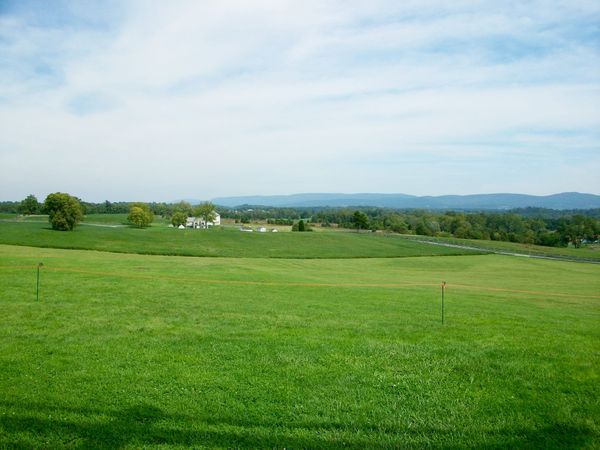
I've been to Maryland several times — some trips purely for pleasure and sightseeing, others for genealogy research. One of the places we visited that has stayed with me is the site of the Civil War Battle of Antietam, also known as the Battle of Sharpsburg. Many of the young men who woke up that morning were also in Maryland for the first time. But they were not there for pleasure — they were there for war, and for many, for death. At this point, I have not confirmed any ancestors who fought i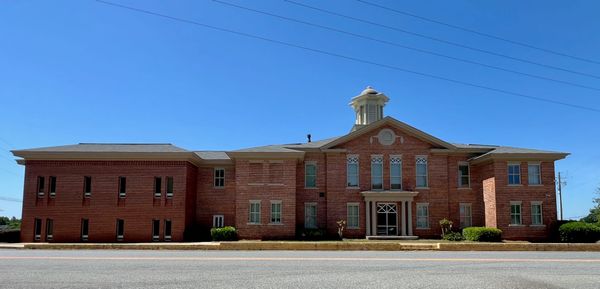
Did the Georgia Wilkinson County Courthouse Have a Curse on it?
The bane of genealogists and historians is courthouse burnings, especially those in the South. I wanted to stop by the little town of Irwinton to follow up with some possible genealogical research at the local library and historical society. I already knew about the Wilkinson County courthouse fire in 1924, but I had not realized just how many there had been. How could this county be so unlucky! But there might be a chance that there were some remnants of my McCullar and Pace families who had se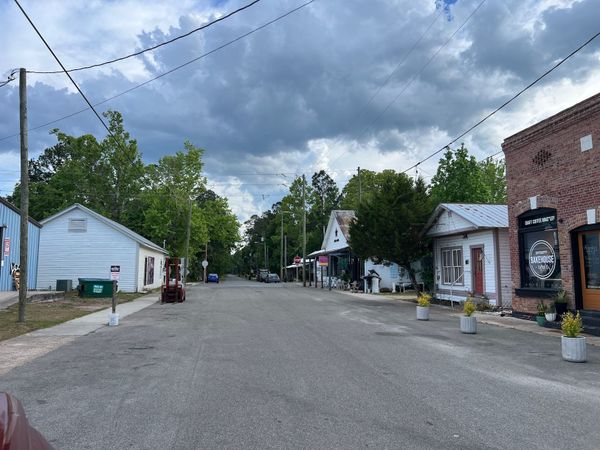
Worm Gruntin' and Family Roots - Searching for Emily in Sopchoppy, Florida
If you know where Sopchoppy, Wakulla County, Florida, is... well, you must either live there or live nearby, since it is not a very big place or known for having many famous people from the area. However, there is one thing that it is famous for, charming worms [Yes, you heard that right!] out of the ground during its annual American Worm Gruntin' Festival. It sounds like fishing must be really popular around there, eh? However, for me, Sopchoppy is famous as the place where my 2nd Great-grandmo
Maryland, Antietam, and a Possible Ancestor's Fate
I've been to Maryland several times — some trips purely for pleasure and sightseeing, others for genealogy research. One of the places we visited that has stayed with me is the site of the Civil War Battle of Antietam, also known as the Battle of Sharpsburg. Many of the young men who woke up that morning were also in Maryland for the first time. But they were not there for pleasure — they were there for war, and for many, for death. At this point, I have not confirmed any ancestors who fought i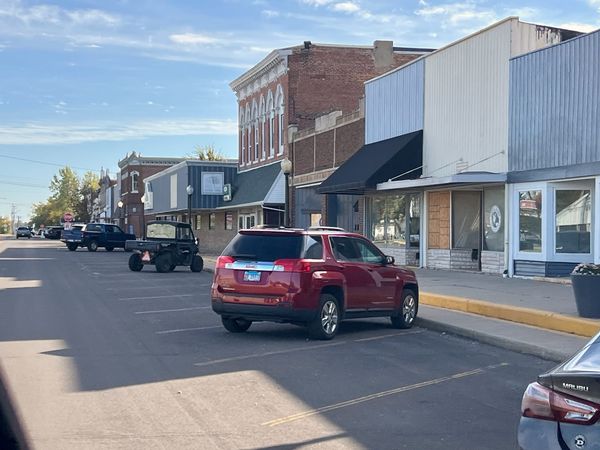
Leaving Minonk
The Eiben Family and the Road to Texas In the 1880s and 1890s, Minonk, Illinois, sat at the junction of multiple major rail lines. The city of Minonk, located in Woodford County, also had numerous new German immigrants who had come to work in the coal mines, supply lumber to the booming city of Chicago, or farm the surrounding area and nearby lands in LaSalle County. We had decided to detour to LaSalle and Woodford Counties to research my mother-in-law's family, the Eibens. Her great-grandfa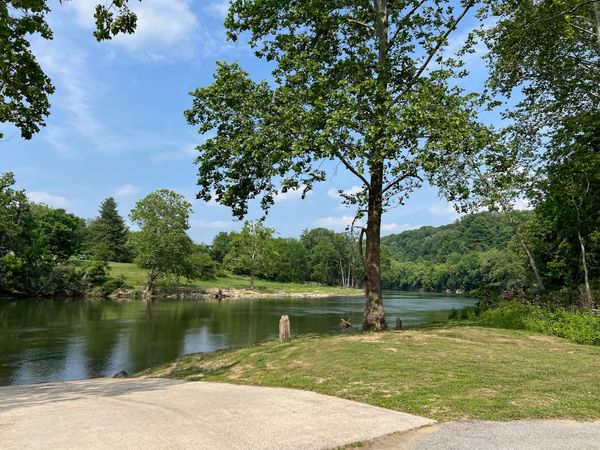
Moses Austin - Virginia's Forgotten Founding Father
When you think of Virginia, you think of George Washington and Mount Vernon, Thomas Jefferson and Monticello, James Madison and Montpelier, along with other famous Virginians. However, you usually do not think of Moses Austin as one of those other famous Virginians. But he should be considered one of them because there are not many people who helped start a new country, and one that would later become the proud and great State of Texas! Located in New River State Park and Austin Memorial Park i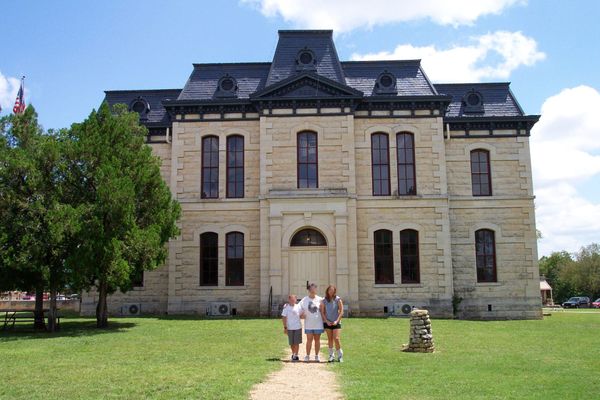
Texas Courthouses and the Stories They Tell!
I admit it! I have traveled through Texas for many years. Whether by car, plane, or train (yes, by train, too), there are very few counties and courthouses I haven't visited. I also admit that it has taken me years to visit them. Texas has a total of 254 counties! (The next state in terms of the number of counties is Georgia, with 159.) I have been to the largest county, Brewster, and to the smallest county, Rockwall. After a while, it seems that some of these courthouses begin to look alike. Wa